Home › The Journal › Buyer's Guide
The Journal · Buyer's Guide
One-to-One vs Group Swimming Lessons: An Honest Comparison
Most children in this country learn to swim in a group class at the local pool, and a great many of them learn perfectly well. Private lessons are not automatically better. They are better for particular children, at particular stages, and it is worth knowing which before you choose.
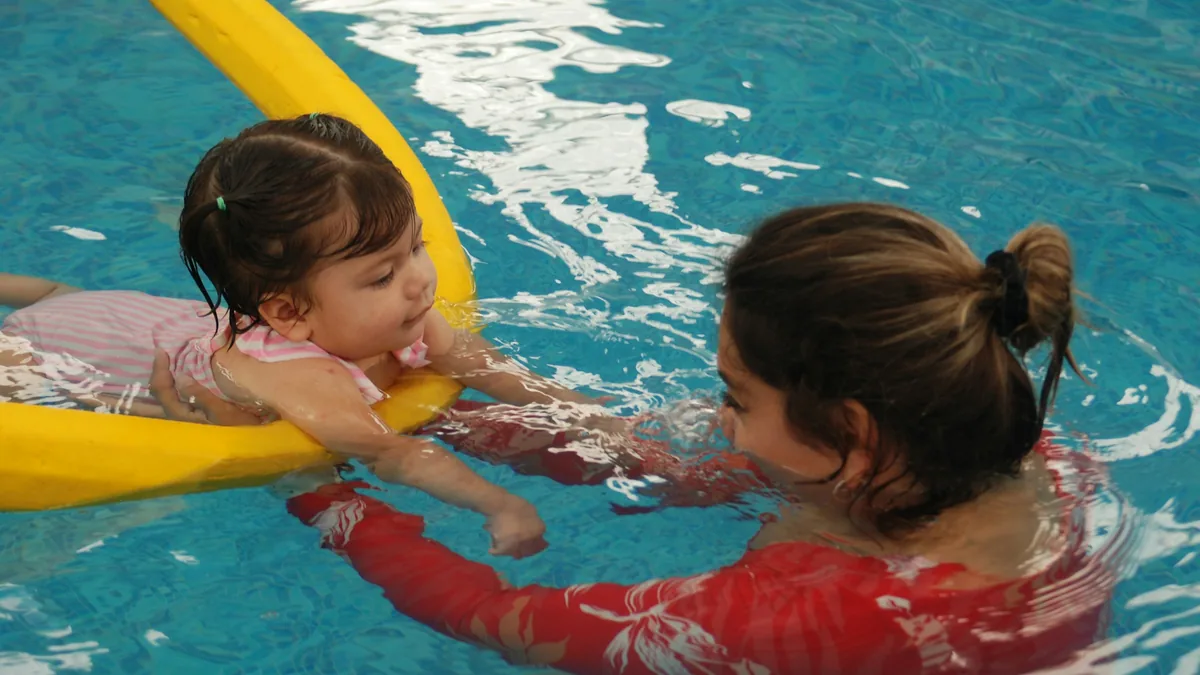
We are a private coaching company, so you would expect us to say that private lessons are the answer. Sometimes they are. But plenty of the children we teach came to us after a group class did not suit them, and we would rather tell a family plainly when the local leisure centre is the better fit. So this is the comparison as we see it from the water, including the parts that do not favour us.
The short version: the question is not "private vs group swimming lessons" in general, it is which format suits this child, right now. A confident six-year-old who loves being with other children and a nervous four-year-old who will not put their face in are not choosing between the same two things.
What a group lesson actually is, and what it does well
A typical leisure-centre or swim-school class puts one teacher with a group of children of roughly similar ability, for half an hour, once a week, usually in a shared pool with other lessons and lane swimming going on around them. Most follow a structured learn-to-swim scheme with stages or badges, so a child moves up a group when they meet the criteria for the next one.
That model has real strengths, and it is worth naming them properly.
- Other children. Plenty of children are motivated by the group. They copy each other, they want to keep up, and the lesson is a social event they look forward to.
- Structure and continuity. A term-based programme with clear stages gives a child something to work towards and gives parents an easy way to see progress.
- Familiarity with public pools. Noise, changing rooms, other swimmers and waiting your turn are all part of real-world swimming. A child who has only ever swum at home still has to learn that environment.
- Accessibility. Group classes are widely available and, for most families, the most affordable way to get a child into the water every week.
For a child who is comfortable in water, gets on with other children and is progressing steadily, a good group class is often exactly the right choice. We would not try to talk a family out of it.
What changes in a private lesson
The difference is not a better teacher or a secret method. It is attention and time in the water. In any group, the teacher's attention is shared, and each child spends part of the lesson waiting at the wall while others take their turn. In a one-to-one lesson the coach is watching one swimmer for the whole session, correcting each attempt as it happens, and the child is working rather than waiting.
That changes a few things in practice:
- The lesson starts where the child is. There is no need to fit a group plan. If a child is stuck on floating, the whole session can be about floating, approached three different ways until one clicks.
- Fear gets handled, not managed around. A frightened child in a group often ends up holding the side and observing. One-to-one, the coach can go at that child's pace without anyone else waiting on them.
- Feedback is immediate. Small faults in breathing or kick get corrected on the next length, before they become habits.
- The setting can be quieter. At home, in your own pool, there is no noise, no audience and no cold walk from the changing room. For some children that alone removes most of the anxiety.
The difference is not a better teacher or a secret method. It is attention, and time actually spent in the water.
Are private swimming lessons worth it?
It depends on what you are trying to fix. Private lessons tend to be worth it in a fairly recognisable set of situations:
- A child who is frightened of the water, or who has had a bad experience and now refuses to get in.
- A child who has been in group lessons for a long time and has stalled at the same stage, usually on one specific skill such as breathing or deep water.
- A child who finds busy, noisy pools overwhelming, including some children with additional needs, for whom a calm, familiar setting makes the real difference.
- A family with a deadline: a holiday with a pool, a school swimming assessment, or simply wanting a child safe in the home pool before the summer. A crash course of several sessions close together often moves a child further than the same number of weekly lessons spread over months.
- A household with its own pool, where the most important thing is that the child is safe and confident in that particular water, at that particular depth.
- A family whose diary will not fit a fixed weekly class slot, because of school, travel or siblings' activities.
If none of those apply, and your child is happy and moving up the stages in a group, the honest answer is that private lessons may not be worth changing to. They will probably still help, but the gain will be smaller than it is for a child who is genuinely stuck.
When a group class is the better choice
We say this to families fairly often. A group class is likely to suit better when:
- the child is already confident and enjoys being with other children;
- they are progressing steadily and the main need is regular practice rather than specific fixes;
- the social side is the point, and lessons are as much about friends as technique;
- you want a long-term weekly routine at the most modest weekly cost.
Some families do both: a weekly group class for routine and company, plus a short private block when something specific needs work, such as a fear of deep water or a stroke that will not come together. That is a perfectly sensible way to use private coaching.
One-to-one, two-to-one or a small group
"Private" does not have to mean a single swimmer. At SwimFitz we coach 1:1, 2:1 or a small group, in your own pool or a private pool near you. The difference from a public class is that you choose who is in the water: two siblings, a child and a parent, or a few friends of a similar level. It keeps some of the social energy of a group without the waiting or the noisy pool.
As a rough guide, one-to-one suits a nervous beginner, a child with a specific block, or anyone on a deadline. Two-to-one works well for siblings who are close in age and ability, or for a parent learning alongside a child. A small group suits children who already swim and are motivated by company. A good coach will tell you honestly if the mix is not working, for example if one sibling is racing ahead and the other is falling back.
On cost, we do not publish a price list in our articles, because it depends on the format, where you are and how often you want lessons. If you would like a figure for your situation, the quickest route is to send us your details and we will come back to you directly.
Questions to ask before you choose
- Is my child confident in the water, or are they still frightened?
- Have they been stuck at the same stage for more than a term or two?
- Do they enjoy the noise and company of a busy pool, or does it wear them out?
- Is there a deadline, such as a holiday or a pool at home they need to be safe in?
- Can our week genuinely fit a fixed class slot, every week?
- Would siblings or friends learn well together, or would one hold the other back?
The bottom line
Group lessons are a good, proven way for many children to learn to swim, and if your child is thriving in one, keep going. Private lessons earn their place when something specific is in the way: fear, a plateau, a busy pool that overwhelms, a deadline, or a home pool that needs a confident swimmer in it. Our children's lessons page explains how we work with children at each stage, and if your child is anxious in the water, our fear of water page covers that in more detail. Whichever you choose, the thing that matters most is that your child keeps swimming regularly and enjoys it.
Frequently asked questions
Are private swimming lessons better than group lessons?
Not for every child. Private lessons give one swimmer the coach's full attention and more time actually swimming, which helps most with fear of water, a stalled stage, or a deadline. A confident child who enjoys other children and is progressing steadily often does very well in a good group class.
Are private swimming lessons worth it?
They are usually worth it when something specific is holding a child back: fear, a plateau at one stage, a busy pool that overwhelms them, or a need to be safe in a particular pool by a certain date. If a child is happy and moving up in a group, the gain from switching is usually smaller.
Does SwimFitz only teach one-to-one?
No. We coach 1:1, 2:1 or a small group in your own pool or a private pool near you. You choose who is in the water, so siblings, a parent and child, or a few friends of a similar level can learn together.
How much do private swimming lessons cost?
It depends on the format, your location and how often you want lessons, so we quote for each family rather than publishing a single figure. Send us your details through the booking page and we will come back to you with options for your situation.
More from The Journal
Teaching a Child to Swim at Home: What Actually Works
Practical, expert guidance from the SwimFitz Journal.

Why Families Choose SwimFitz Over Marketplace Sites
Practical, expert guidance from the SwimFitz Journal.
Private Pool Safety: A Complete Guide for Families
Practical, expert guidance from the SwimFitz Journal.
Not sure which format suits your child?
Tell us where your child is now and we will suggest 1:1, 2:1 or a small group, at your own pool across London, the Home Counties & beyond.
Make an Enquiry → Children's Lessons