Home › The Journal › Prenatal
The Journal · Prenatal
Pregnancy Swimming: Benefits and Safe Practice
Water is the one place in pregnancy where you stop carrying the weight. It is also the form of exercise most often recommended and least often explained. Here is what the guidance actually says, which stroke to choose as your shape changes, and how to keep swimming comfortably right through to the third trimester.

Almost every pregnancy guide mentions swimming. Very few go further than the word itself, which leaves a great many women standing at the edge of a pool wondering how far, how fast, how warm, and whether any of it is a good idea.
It usually is. The NHS recommends around 150 minutes of moderate activity a week during a healthy pregnancy, and swimming is among the forms it names specifically — largely because the water carries the weight your spine, pelvis and knees have been carrying since the first trimester. What follows is the practical detail: the benefits worth knowing, the safe-practice points that matter, and the stroke-by-stroke adjustments a coach would make for you.
One caveat first, and it is not a formality. This is general guidance, not medical advice. Speak to your midwife or GP before you start, especially if your pregnancy has any complications, and tell any coach or instructor that you are pregnant so they can adapt the session.
Why water suits pregnancy so well
Buoyancy is the whole argument. By the third trimester you may be carrying an additional stone or more, almost all of it in front, pulling your posture forward and loading the lower back and pelvis. Step into chest-deep water and most of that load disappears. For many women it is the only hour in the week when nothing aches.
The secondary benefits follow from the same mechanism. Swimming is non-weight-bearing, so it maintains cardiovascular fitness without pounding the joints. The horizontal position and the gentle pressure of the water help with the swelling that builds in the ankles and feet. And unlike most land exercise, it is very hard to overheat while you are doing it, provided the pool itself is not too warm.
There is a psychological argument too, and we would not dismiss it. Pregnancy involves a long run of appointments in which your body is measured, monitored and discussed. Swimming is time in your body rather than time being assessed — quiet, rhythmic, and entirely yours.
The safe-practice points that actually matter
Most pregnancy swimming advice is either alarmist or so vague it is useless. These are the points that genuinely change what you should do.
Water temperature
Comfortably warm, not hot. Dedicated aquanatal sessions usually run at around 30 to 32 degrees. Hot tubs, saunas and steam rooms are a different matter and are best avoided — raising your core temperature is not advised in pregnancy. At the other end, water cold enough to make you tense and brace is counterproductive when the whole point is to unload.
Intensity
Use the talk test. If you can hold a conversation, you are working at the right level. Pregnancy is not the time to chase personal bests or start an entirely new high-intensity programme, but if you were already a strong swimmer you can generally continue at a sensible level for far longer than most people expect.
Lying on your back
After roughly 16 weeks, avoid long periods flat on your back on land. In the water, backstroke is usually fine because you are moving rather than static and the pressure is quite different — but back floating for extended stretches is worth avoiding, and if it makes you feel light-headed, stop.
Getting in and out
Statistically, the pool is rarely the risk. Wet tiles, ladders and a shifting centre of gravity are. Use steps with a handrail rather than a ladder, take the poolside slowly, and do not rush the transition.
When to stop
Get out and seek advice if you have bleeding, contractions, fluid loss, chest pain, dizziness, severe breathlessness or calf pain and swelling. And do not swim once your waters have broken.
The pool is rarely the hazard. The walk to it usually is.
Stroke by stroke, as your shape changes
This is the part most guidance skips, and it is where a coach earns their keep.
Front crawl is generally the most comfortable stroke throughout pregnancy. The body position is flat and long, the bump sits in the water rather than against it, and the leg action is small. The one adjustment worth making is breathing: as the ribcage expands and lung capacity feels reduced, most women are more comfortable breathing every two strokes to one side rather than bilaterally every three.
Backstroke is comfortable for many and opens out the chest and shoulders, which is welcome when posture is being dragged forward. Keep it moving rather than static, and drop it if it makes you feel at all faint.
Breaststroke is the one to watch, and it is the stroke most women default to. The wide, circular leg kick loads the pelvis exactly where pregnancy has already loosened it, and it is a common aggravator of pelvic girdle pain. If you feel discomfort at the pubic bone or across the back of the pelvis, that is your signal to switch to front crawl rather than to push through. The traditional heads-up breaststroke also hyperextends the neck and lower back, which is uncomfortable for most women by the third trimester.
Butterfly is worth setting aside. The undulation asks a great deal of a midsection that is already under strain.
Beyond the four strokes, some of the most useful pregnancy work is not swimming at all: walking lengths in chest-deep water, gentle sculling, supported floating and mobility work in the shallow end. Our pregnancy swimming sessions often use more of this than actual lengths, particularly in the final weeks.
Why so many women stop before they need to
In our experience, women rarely stop swimming during pregnancy because it becomes unsafe. They stop because of everything around it.
Public pool changing rooms are cold, crowded and often a long walk from the water. Lane swimming means negotiating people who have no interest in your circumstances. Aquanatal classes are excellent but run at fixed times that rarely suit first-trimester nausea or third-trimester fatigue. And a great many women simply do not want to be looked at.
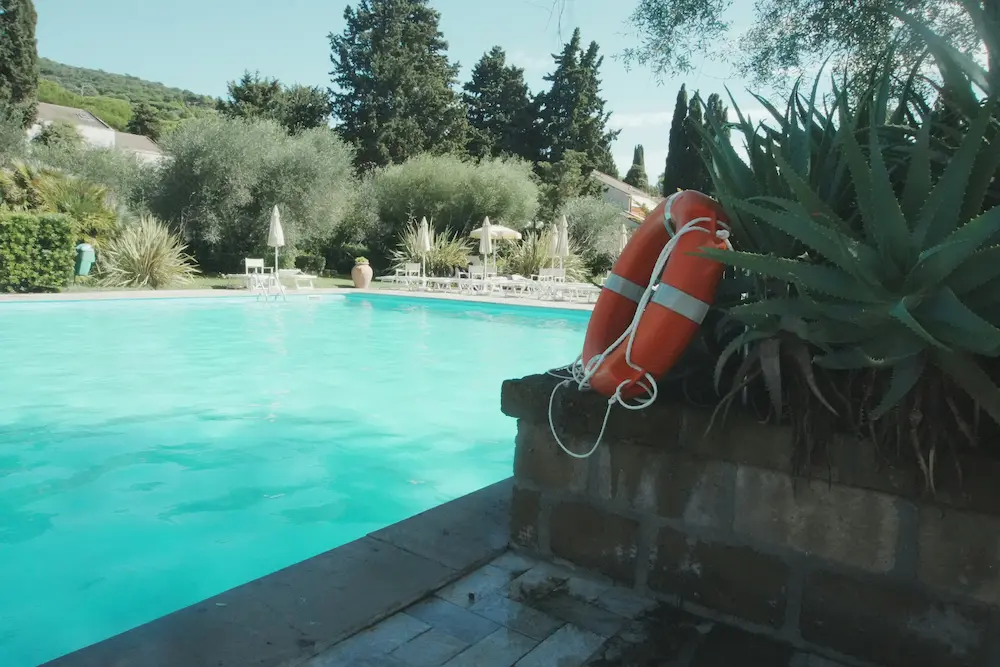
This is the specific problem that swimming in a private pool solves. The water is a few steps from your own bathroom, the temperature is set to suit you rather than a timetable, the session moves when you need it to move, and nobody is watching. For clients who do not have a pool at home, we coach at private and hotel pools across our network — the point is the control, not the postcode.
It also makes the coaching itself more useful. A one-to-one session can be rebuilt week by week as your body changes, which is not something a fixed class can do.
A sensible pregnancy swimming session
- Check with your midwife or GP first, and tell your coach or instructor you are pregnant
- Water comfortably warm — around 30 to 32 degrees — and no hot tubs or saunas
- Use the talk test: conversational pace throughout, never breathless
- Favour front crawl and backstroke; drop breaststroke if the pelvis complains
- Enter and exit by steps with a handrail, never in a hurry
- Hydrate — you sweat in water, you simply cannot feel it
- Stop for bleeding, contractions, fluid loss, dizziness, chest pain or calf swelling
Afterwards
The return to water is more conservative than most people assume. Standard guidance is to wait until postnatal bleeding has stopped — usually at least seven clear days — and until you have had your postnatal check. After a caesarean or any complications, follow the advice you are given, which is often considerably longer.
When you do return, treat it as a rebuild rather than a resumption. The abdominal wall and pelvic floor have both been through a great deal, and the first few sessions should be about gentle movement and breathing rather than distance. Many of our clients move from pregnancy sessions straight into adult one-to-one lessons, and later into baby swimming with the child they were carrying — which is a rather satisfying way for it to come round.
The short version
If your pregnancy is healthy and your midwife is content, swimming is one of the best things you can do for the next nine months. Keep it conversational, keep the water warm rather than hot, favour front crawl over breaststroke if your pelvis objects, and take the poolside slowly.
And do not stop for the wrong reasons. If it is the changing rooms, the timetable or the audience that is putting you off rather than the swimming itself, those are all solvable problems.
Frequently asked questions
Is swimming safe during pregnancy?
For most women with a healthy, uncomplicated pregnancy, yes. The NHS lists swimming among the recommended forms of activity in pregnancy because the water supports your additional weight. Always confirm with your midwife or GP first, particularly if you have any complications, and tell any instructor or coach that you are pregnant.
How warm should the water be for pregnancy swimming?
Comfortably warm rather than hot. Aquanatal sessions typically run at around 30 to 32 degrees Celsius. Avoid hot tubs, saunas and very warm water, as raising your core temperature is not advised in pregnancy — and avoid water cold enough to make you tense up.
Which swimming stroke is best when pregnant?
Front crawl and backstroke are usually the most comfortable. Breaststroke is popular but its wide leg kick can aggravate pelvic girdle pain, so if you feel discomfort at the front or back of the pelvis, switch strokes. After around 16 weeks, avoid spending long periods lying flat on your back.
When can I start swimming again after giving birth?
Standard guidance is to wait until any postnatal bleeding has stopped — usually at least seven clear days — and until you have had your postnatal check. If you had a caesarean or any complications, follow your midwife or GP's advice, which is often longer.
More from The Journal
Private Pool Safety: A Complete Guide for Families
Practical, expert guidance from the SwimFitz Journal.

Teaching a Child to Swim at Home: What Actually Works
Practical, expert guidance from the SwimFitz Journal.

Coaching on Holiday: Lessons at the Villa or Yacht
Practical, expert guidance from the SwimFitz Journal.
Confidence in the water starts with lessons
Private, one-to-one coaching at your own pool — for babies, children and adults across London, the Home Counties & beyond.
Request a Lesson → Explore Lessons